
At Solutions for the Planet, we’ve always believed that environmental challenges are best tackled together. Not as isolated lessons in a classroom, but as shared experiences that connect young people, families, schools and communities.
That principle guides all our programmes. When learning is rooted in real action and supported by a wider network, young people see that sustainability isn’t something they face alone, it’s something they can lead alongside others.
That’s why we are proud to be partnering with Race Against Waste to bring their innovative E–Waste Race programme to the UK for the first time, creating a collective challenge that turns awareness into action across schools and communities.
This pilot in Kingston‑upon‑Thames, involving ten primary schools and a network of committed partners, is demonstrating what becomes possible when learning, community action and sustainability come together with one shared purpose, with over 1700kg of material collected so far.
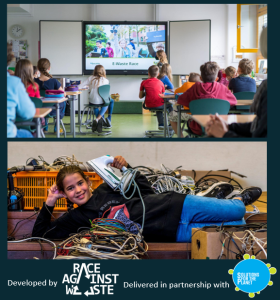
Why the E-Waste Race Matters
Electronic waste is one of the fastest‑growing waste streams in the world, yet it often goes unnoticed – old phones in drawers, unused chargers in cupboards, devices we no longer need but never quite dispose of. Individually these items seem small; collectively they represent a significant environmental challenge.
The E-Waste Race makes this issue visible. It turns a passive problem into active learning and community action. Students aren’t just learning about sustainability, they’re leading it.
Students have been challenged to collect as much e-waste as they can over a 4-week period and bring it into school to be either repaired or recycled by our e-waste partners. The school who collects the most waste wins a STEM enrichment experience of their choice for their school. And so far, the competition has exceeded all expectations with students collecting 1000kg of e-waste in only the first 2 weeks!
Where Competition Sparks Collaboration
Yes, it’s called a “race”. And there will be a winning school. But we’ve learnt over the years that the most powerful things in programmes like this rarely sit with the headline outcome.
Because what’s happening across Kingston right now is not ten schools competing in isolation, it’s ten schools moving forward together.
We’ve already seen the early signs of this:
- Young people becoming curious about the importance of E-waste management.
- Students engaging their peers, teachers, families and carers
- Communities becoming part of the solution
The competitive element creates energy, but the collective effort is what drives meaningful change.
A System Brought Together
One of the things we’re most proud of in this work is that it doesn’t rely on one organisation “delivering” something to others. Instead, it brings people together – each playing a role, each contributing something essential.
This is collaboration in action:
- Race Against Waste being the brains behind the model and providing vital support
- Fairphone funding the programme, enabling it to happen
- Kingston Council bringing partners together around a shared local priority
- LimeTrack supporting the infrastructure by providing smart bins free of charge
- Relove Technology managing the collection and logistics
- Solutions for the Planet coordinating and facilitating the programme
- Schools and students driving the action on the ground
- Communities coming together to responsibly despose of their E-waste
No single part could deliver this alone. But together, it becomes something I think we need to see more of: A joined-up system that turns intention into action, and action into impact.
Learning That Sticks
There’s something fundamentally different about learning when it feels real. And that’s what stands out to us here, not just what young people are learning, but how they’re learning it.
Students are applying science through real materials, using maths in a context that matters by tracking progress and measuring impact, developing leadership as they organise and motivate others, and strengthening their communication skills by engaging people beyond the classroom.
But perhaps most importantly, they are experiencing what it feels like to make a difference and to see something change because of their actions. We’ve always believed this that
once a young person feels that sense of agency, it doesn’t leave them. That’s the kind of learning that stays.
Hope in Action
As you all know, we always come back to hope. But not the abstract kind. The practical kind. The lived kind. And there is something deeply hopeful about this.
Ten schools moving in the same direction. Organisations stepping forward to play their part. Young people not just learning about sustainability – but actively shaping it.
This is what hope looks like in practice. And perhaps the most important question this raises is not what happens during the race, but what happens next, because once young people experience what it feels like to create change together, it becomes part of how they see the world.
📸Photo credit: Race Against Waste, Netherlands.